
To Be Thankful
An American holiday for complicated times

Thanksgiving has always been my favorite holiday, a reflection of the nation I love in all its complexities and messiness.
The simplistic story we were taught as children, like so many of our founding tales, is one we’ve since come to understand as selective and sanitized mythmaking. We can and must confront the injustices in this country’s narrative, including the Thanksgiving chapter and the chasm between the ideal of a shared bounty between colonists and Native people and the much darker realities of history.
Contradiction permeates the American story, and none greater than the declaration that all men are created equal set against the violent and destructive inequities that have plagued our nation since its conception.
But this holiday is also one of hope and renewal, a celebration of the harvest and of our common humanity. And we would be wise to recognize, as we gather with family and friends in often complicated community, that the aspiration to share time and place with people different from ourselves, in mutual respect and gratitude, is a vital part of our national inheritance.
This is a holiday where many of us find ourselves traveling great distances, sometimes measured in literal miles, and sometimes tallied in crossing the divides of culture, politics, religion, or the many categories that make up the diversity of the United States. Part of what we celebrate today, beyond our personal gratitude, is the ideal that we can gather with others despite our differences. A small model for what the country could be.
Sometimes the tensions between us are too raw, the disagreements too deep, the history too painful for us to come together with family or with others who were once in our lives. Others among us find themselves suffering this holiday from illness, financial strain, or other destabilizing forces. Many of us are alone. The sadnesses of life are not lifted by a simple “Happy Thanksgiving.”
Yet the season still carries a stubborn current of optimism that, like our nation more broadly, we can find our way back to common ground.
Much of what you and I talk about here is how this age of autocracy and corruption has strained the bonds of our national identity, making it increasingly difficult for us to return to the democratic norms and ideals that once seemed to guide our political and social progress. But just as the mythmaking of the Thanksgiving story can blind us to hard truths, so too can nostalgia for a past that never really existed.
The truth that leaps out at us from across our history is that building a democracy, and then maintaining it, is difficult and unending work. The United States was conceived with an aspiration unlike any that had been put into practice in human history, a belief that a set of ideals could be strong enough to create a national identity powerful enough to stitch together the quiltwork of our human family.
I’ve been reminded of how audacious and improbable an assumption this was by watching Ken Burns’ latest documentary series on the American Revolution. What comes through beautifully is how complicated and diverse our nation was at the beginning: thirteen independent colonies that saw themselves as separate entities, with remarkably varied populations. The struggle was not only against the common enemy of an imperial monarch but also, in many places, a bloody civil war between those who wished to remain British subjects and those who demanded independence. A patriot in one person’s eyes is a rebel in another.
And of course many other forces that have tragically shaped this country were also present. Those rebelling rallied around a notion of liberty and declared they would not live like slaves to the British king, even as they enshrined the institution of slavery into a new nation. And for all the talk of resisting an empire, the colonists also had their eyes on unfettered westward expansion and the continental-scale displacement, or disappearance, of the Native inhabitants already living there.
The chasms and contradictions that permeate the story of the United States give ample fuel to the cynic who sees only the gaps between our ideals and our reality. Thanksgiving, seen through this lens, can deepen that disillusionment. All of that is real. But I’ve come to believe that if we recognize we will always be on a journey toward greater equality, empathy, and a more inclusive democracy, then this gulf between our ideals and our current reality can also serve as a North Star, a fixed point of moral clarity we can use to plot our path toward greater progress.
So it is in that spirit that I greet all of you this Thanksgiving. Among the things I am most thankful for is you and the community you have helped me build. You have encouraged me to find my voice and share my thoughts. For that I am, and will always be, profoundly grateful.
This Thanksgiving, my family and I have come to my parents’ house in Massachusetts, not far from where the first shots were fired 250 years ago that changed world history. It is also not far from where my love of this nation, and my desire to understand its contradictions, led me to study American History and Literature nearly 30 years ago.
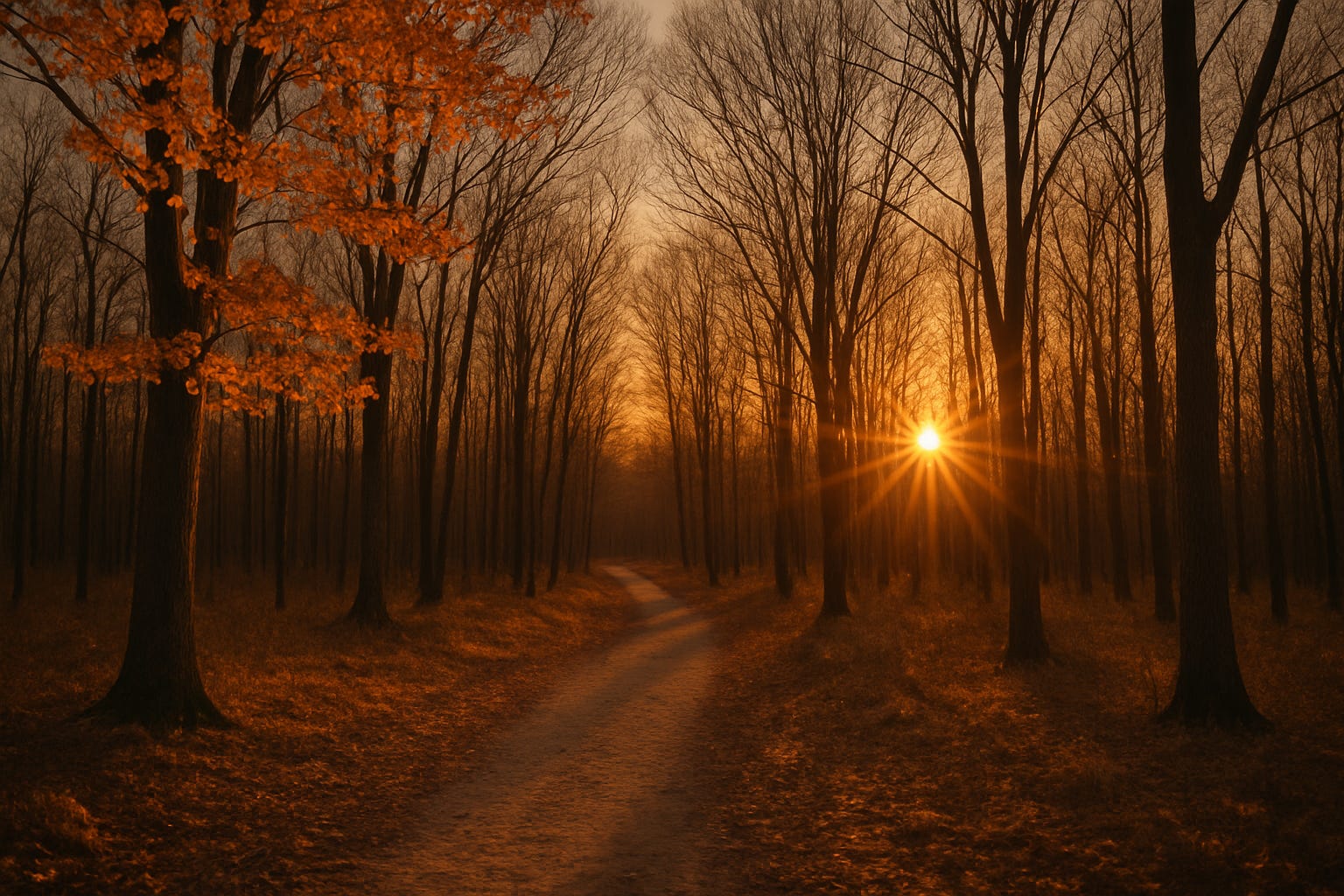
My two brothers are here with their families. We take a walk on a warm fall afternoon. The trees are well past peak foliage, but there is something about the coming winter that I have always found bracing, clarifying, and beautiful. A neighbor stops by to say hello amid a pickup basketball game in the driveway. She says she appreciates my writing here, even if she doesn’t always agree with me. I appreciate her sentiment, the dialogue, and her point of view.
Our family has changed a lot since my childhood, just like the nation. We have had our share of happy and challenging chapters. But as I watch my children gather with their cousins, I remember times past and feel a surge of hope. Their generation will inherit a difficult work in progress, like all those who came before. But they are far more attuned than I was at their age to the struggles they will have to confront. They are more nuanced in their understanding of what Thanksgiving can mean, and they embrace the future with the youthful energy that has propelled this still-evolving nation since the beginning.
I feel a similar sense of hope engaging with all of you, a well-earned belief that some future documentarian will look back on this moment and see not only the challenges we faced but what we managed to overcome. That our improbable and messy national story will keep unfolding, propelled by our continued work toward that more perfect union.
Happy Thanksgiving.
Thank you, for taking time and effort to focus on a meaningful analysis of a message of thankfulness in an atmosphere of hope and love over coming hate. Much appreciated.
Happy Harvest Home and Indigenous Peoples' Day, Elliot. We give thanks for all here.
May you all always have enough.