
Uncle David
We shall not see his like again

My Uncle David died on Saturday. The news hits hard. He had been ill but seemed to be getting better. And now, suddenly, he’s gone.
As the sun rose on this beautiful, crisp fall morning, my mind filled with memories and my heart ached, especially for my beloved Aunt Paula and my cousins Evan, Benjamin, and Robyn.
I wish you all could have known David. He was unlike anyone I’d ever met. And I think most people who knew him felt the same.
Born in rural Georgia, he left home as a teenager and traveled the world in the Merchant Marines. He was a paramedic, a stuntman, a crane operator on movie shoots, and a caretaker at the Chicago-area temple of his adopted Bahá’í faith. He mastered Aikido, paid fierce homage to his Welsh ancestry through the bagpipes, and was fond of reciting poetry aloud.
He had great hair and a square jaw. He was charming and mysterious. His life stories always skipped a few chapters, hinting at distant adventures and escapades that were probably best left buried in his own memories.
He entered my life when I was a child—an addition to our Midwestern Jewish family that was at once incongruous and completely natural. His presence stretched our horizons and showed me how wide the world could be, the vitality of lived experience, and how much richer we become when we open ourselves to new perspectives.
Politics and history were constant topics of discussion at family gatherings, and David’s voice always brought bright new colors to the debate. A son of the segregated South, a seasoned wayfarer who had spent far more time dockside than in fancy hotels, a man who worked with both his hands and his mind, he thought nothing of driving his truck hundreds of miles for a gig, could rock a kilt without irony, and would hold forth on history and literature with the ease of a scholar.
When he joined our family, I saw how deeply he loved my grandparents, and how they loved him back—as did we all. I can still picture those snapshots of our younger selves, when everyone was alive and, more importantly, full of life. I remember, as my grandfather fell ill and later my grandmother, how kind and caring David was. He had the bearing and formality of what, in another time, would have been called a gentleman.
He approached the world with a keen sense of justice, could spot a phony without fail, and despised those who used wealth and power to oppress people on the margins. Naturally, he detested our current regime—intellectually, intuitively, and emotionally.
We live in a time when thought and experience are flattened, when algorithms push us toward smaller versions of ourselves and narrow the ways we understand identity. We see growing chasms where there should be common humanity. It is the antithesis of what this nation should stand for—and of the world David inhabited. Thinking about what he brought to our family and to my life, and what lessons that holds for our time, I turn to another son of rural Georgia: Jimmy Carter.
Fifty years ago, Carter spoke about the strength of diversity and the promise of immigration. His words feel even more urgent today, amid the hate and division we see across the country. It was a plea for finding common ground, and it resonates if you think not only of country but also of family.
Our country is made up of pluralism, of diversity—a lot of different kinds of people. But that’s not a sign of weakness; it’s a sign of strength. Some people have said our nation is a melting pot. It’s not. Whether we came here two years, twenty years, or two hundred years ago, it doesn’t matter. The point is why we came.
When we come here, we don’t give up our individuality—our pride in our past, our history, our habits. We become not a melting pot but a beautiful mosaic. Different people, different beliefs, different yearnings, different hopes, different dreams.
All put together to make a beautiful picture of a common people. We came here because we wanted to. Because we believed in this country. Because we felt we could get along with one another—even if sometimes we disagreed.
David not only believed in that vision of America — he lived it. As my Aunt Paula said, he walked through the world as if everyone were his equal, from the man who shined shoes to the president of the United States.
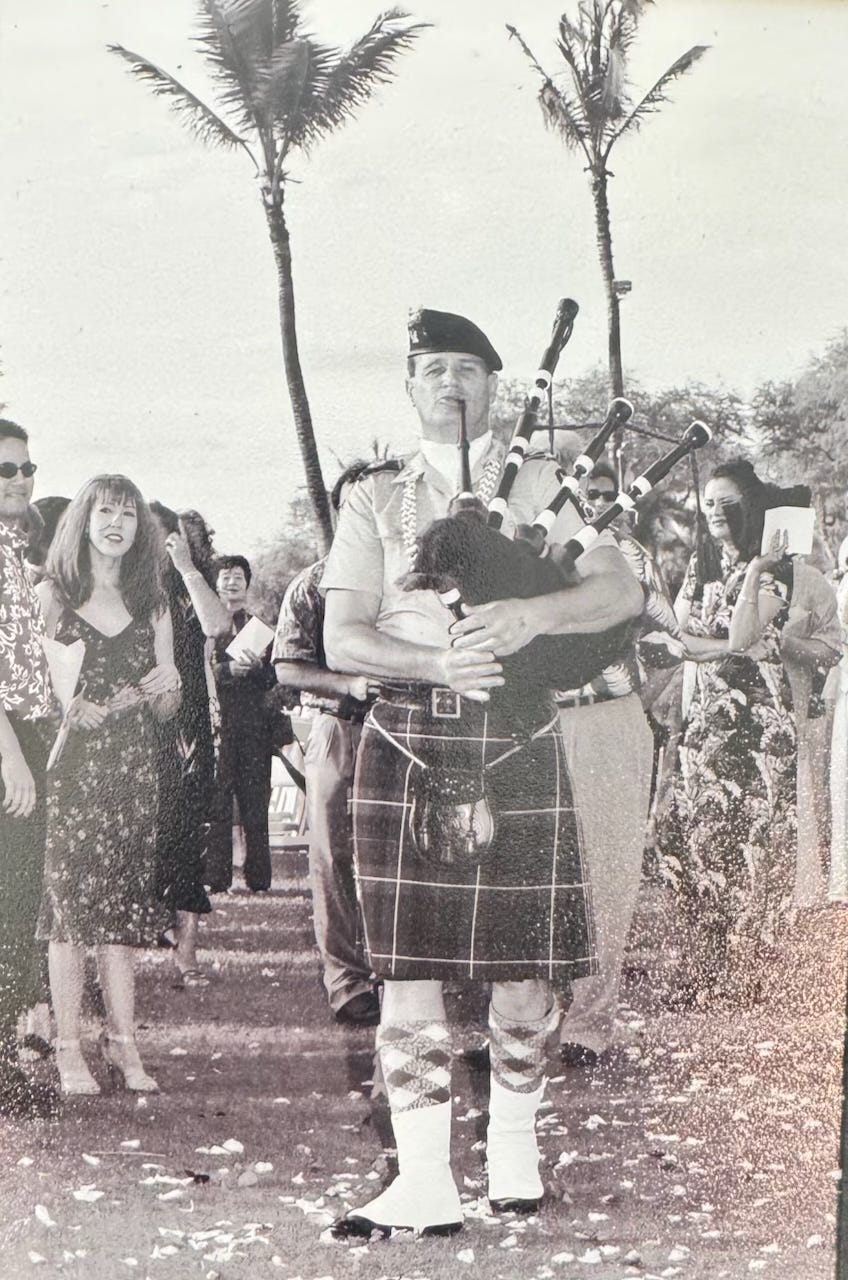
The picture of David at the top of these remembrances comes from one of my most cherished memories: my wedding, when his bagpipes serenaded our walk down a grassy overlook on the shores of Maui, where my mother-in-law’s family had lived for generations. Another of my uncles, Sandy, who has served as a cantor, offered the Seven Blessings of a Jewish ceremony. A family friend of my wife’s, a local judge who is Native Hawaiian, officiated.
It was unique, blended, loving, and deeply American.
And no more so than David, in his full Welsh regalia among the palm trees, surf, and sand.
I will miss him greatly. But I will carry him through the rest of my life, where his memory will always be a blessing.
What a beautiful tribute and how lovely it is to have someone speak your name in this way.
Beautifully written memories. People like your Uncle David deserve to be remembered and celebrated. You were so very lucky to have him in your life, and he for having someone like you who cared so much about him that you could write this, and share him with us.