
Exploiting Trump's Weaknesses
An opportunity to renew American democracy

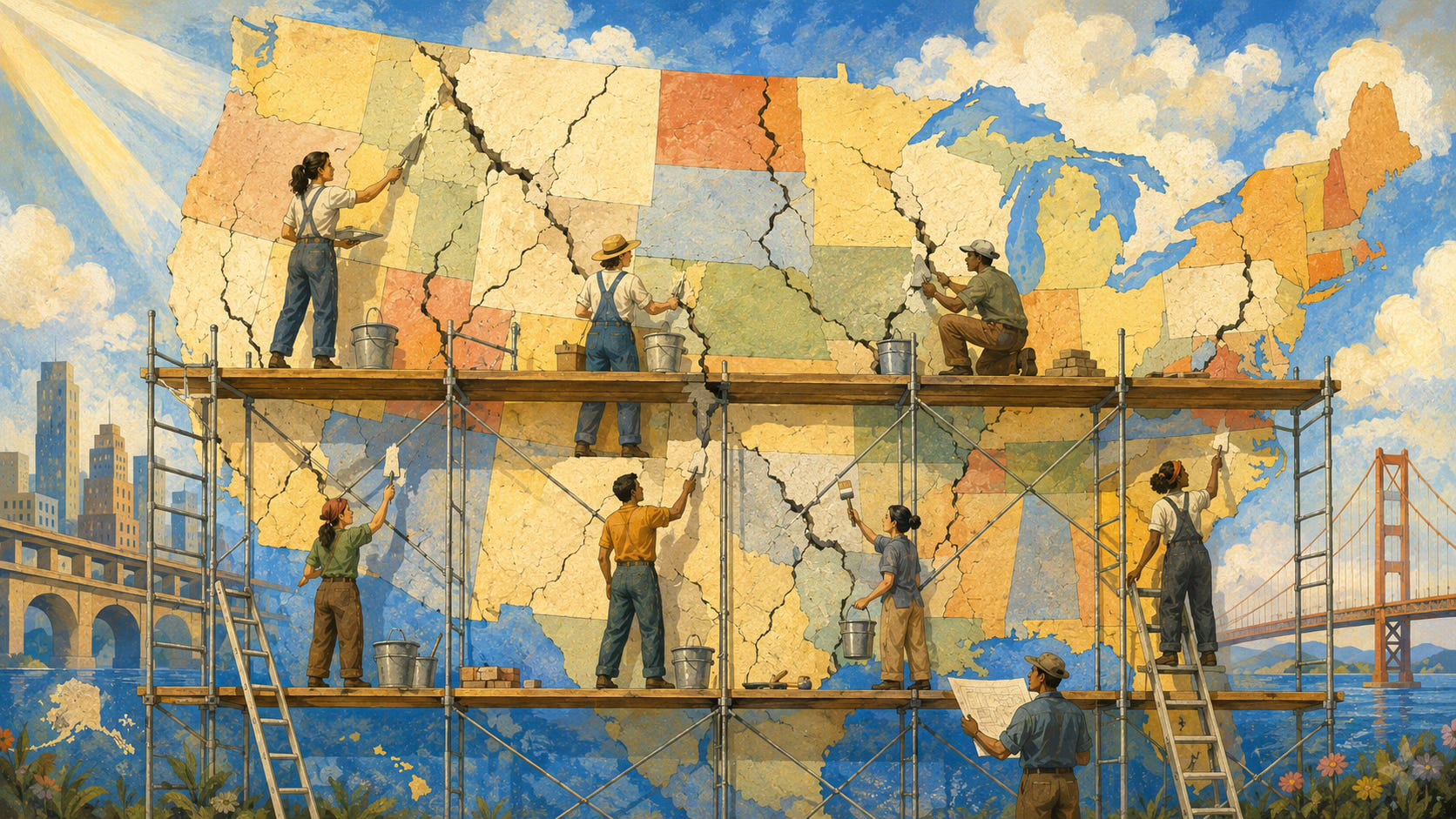
When engineers assess the soundness of a proposed design, whether a building, bridge, or digital system, they don’t just step back and look at the whole. They probe the schematics for points of weakness, for stresses that will build over time, for assumptions that could prove fatal in real-world conditions.
If something goes wrong, failure can ultimately manifest at the scale of complete collapse. But when investigators are called in to deconstruct the chain of events, they often find that it boils down to a single factor, sometimes buried in a component that might once have seemed almost insignificant. A flawed assumption. A rounding error. A single decision point. A missed warning.
Points of weakness can also be exploited by those seeking to defeat a foe. The Greeks entering Troy in a wooden horse. A scientist discovering a new antibiotic. The rebels in Star Wars hitting the thermal exhaust port of the Death Star.
And this approach of honing in on vulnerabilities is essential to defeating the MAGA movement and ushering in a new era of American democracy.
Several weeks ago, I wrote that Trump has become “incredibly weakened by the mounting toll of his incompetence.” I was looking at the totality of his cumulative failures. When it comes to the toll on his standing with the public, as my title suggested, “It’s All Adding Up.”
For those who have seen from the beginning that Trump is craven and corrupt, all of the signals he emits point to catastrophic systemic failure. The words he says, the actions he takes, or doesn’t, and the incompetence and cruelty of his sycophantic cronies have always been so repulsive that it is hard to isolate the awfulness of any single assault on dignity, truth, and the rule of law.
Yet despite provoking strong negative reactions from about half of the American electorate, for most of Trump’s time on the political stage his approval ratings have hovered in the mid-40s, give or take. It was enough for him to eke out victory in 2016. Not sufficient in 2020. But he returned in 2024, somehow more popular than before.
No longer. The polls continue to show that Trump’s approval ratings are plummeting. And that means many people who voted for him in the last election, and likely in the previous two, have become disillusioned.
Trump’s cratering popularity can yield a healthy dose of incredulity: What are these Trump voters seeing now that they didn’t see before?
It’s not an academic question. If the goal is to defeat MAGAism for good, those who oppose it must search for, and then understand, the fault lines in its crumbling support.
On a macro level, many of these are obvious. Inflation. The war in Iran. The fatigue that always sets in with an incumbent party. But those are trend lines that exist in normal political times. And we know this is not a normal time, and Trump is not a normal political phenomenon. Might we find in the fissures of his support less the cyclical sway of political fortune and more the early signs of a structural failure that could herald a very different era?
One of the struggles of covering political movements, or of journalism more generally, is balancing the epic scale with the personal. The human mind tends to respond more to individual narratives and anecdotes than to sweeping data. It’s why sagas about war and peace, including War and Peace, focus on individual actors against a broader backdrop. And it’s why political reporters try to understand larger trends by speaking with individual voters.
I am not always a fan of these kinds of focus groups. They are small sample sizes and easy to manipulate. Unless what you are trying to do is understand deeper truths that can only come from diving into how people talk as, well, people.
That is why I was fascinated by the transcripts of a discussion with 12 disaffected Trump voters a while back in The New York Times.
There are millions of Americans who have hated Trump for a long time for all sorts of reasons. And it may be difficult for those in that camp to understand what is now causing the larger shift. But in this focus group, a fundamental weakness is emerging, one that could collapse his support for good. Of the twelve voters asked to grade his presidency, one gave a C and the rest gave D’s and F’s.
Much of what they said was predictable. Frustration with the cost of food and gas. Disappointment that prices had not come down. The kinds of concerns that surface in almost any period of economic strain.
On other issues, there were many specifics people mentioned that I expected, like supporting stronger border protections but not the outrages of ICE agents. But other notes were surprising. For example, a few mentioned how dismayed they were by the Oval Office meeting with Ukrainian President Volodymyr Zelensky, where Trump allowed J.D. Vance to berate him without stepping in.
Beyond the details, a larger theme emerged. It was more than just frustration. It was disenchantment. Even embarrassment for having believed the promises Trump made.
It reminded me of a news interview that went viral with a woman filling up her car in Pennsylvania. When asked how many times she voted for Trump, she responded, “Three times. That was my bad. Apparently I’m an idiot.”
The big story is that they might not have liked Trump’s character, but they were unhappy with the state of the country and believed his promises on the campaign trail. And now that they see the reality of what he offers, they feel betrayed. They see chaos and confusion instead of progress. And once they start to see it, they find it everywhere, from spiking prices to nasty rhetoric to bizarre obsessions.
Some of the people in the focus groups admitted that their friends and family had been telling them for years how bad Trump was. This could lead to a certain amount of understandable schadenfreude, but that is not a blueprint for winning elections.
The message Democrats must pound is that Trump and the Republicans promised to make things better, and they failed. More than that, they have rigged the government for their corrupt friends at the expense of the American people. They don’t seem to care. They are not to be trusted.
But all that is not enough. I also saw in these discussions a yearning for a positive narrative, something I am seeing echoed in the conversations we are filming for our new film about America at its 250th anniversary.
People want leaders who make a bold pitch for the vision of the country. The Biden administration did a lot of great things, but it somehow could not communicate them, and the narrative became about its failures, real or perceived. That this took hold was not only their fault, but also that of a broken media ecosystem and Republican obstructionism.
Democrats now have a chance to start a new story, to say they have a way to make the country work again for all Americans. This cannot only be a reflexive stance. They should be as bold as Trump was in arguing that they are the only ones voters can trust to fix the country. They should have big ideas. They should vow to root out corruption. They should reinvigorate our democracy so that it is more responsive and representative.
And if they can find a way to deliver, out of the ashes of this dumpster fire can emerge a new political alignment fueling an age of unabashed progress. Supported, in part, by people who once voted for Trump.
My biggest concern is after the inevitable crash of this regime. Many of the country's special places have been contracted to corporations for extraction. Wilderness, watersheds, faultlines filled with gases, sacred spaces for First Nations, endangered species territory. And numbers of dangerous toxins have been greenlit for extended use. Unless you are keyed into environmental issues you will not see many reports on these sales. Corporations are good at providing themselves a lot of time to make money while they are fighting in court. I am very concerned at the damage post-Trump.
His next target is Cuba. Remember the WMDs that were never there? Let’s hope that those in power who can really do something about ridding our country of this “moron” remember that disaster also. Before it’s too late - for everyone. I was born in the 1930s. It’s a shame how this country has fallen so far and so fast.
Bill Hayes from Maine