
Tick, Tick, Tick
Scott Pelley says what needs to be said

In the days leading up to Putin’s attack on Ukraine, the Biden Administration did something remarkable. They called out the thug for who he was. With tens of thousands of Russian troops massed along Ukraine’s border, the Administration declassified intelligence showing that they knew exactly what Putin was preparing to do: invade a sovereign nation, overthrow its democratically elected government, and extinguish its independence.
The strategy is known as “pre-bunking”: getting ahead of the lies before they are ever told. The Biden Administration did all of this publicly, contextualizing Putin’s plans before the tyrant could control the narrative and manufacture his own mendacious version of the “truth.”
That’s what you do with bullies. You call them out. You stand up to them. You let them know that you see through their motives. You undercut their power by exposing their weaknesses. And then you do everything you can to defeat them.
I thought of this when I heard the news about 60 Minutes correspondent Scott Pelley publicly calling out the show’s new executive producer, Nick Bilton, and especially the head of CBS News, Bari Weiss, earlier this week. As many of you probably know, the most famous television news program in American history has become the scene of the latest assault by MAGA forces on a free and independent press.
I have written here multiple times about how the Trump-friendly oligarchs Larry Ellison and his son David have set about to destroy CBS News after their purchase of Paramount. And how installing Weiss, an ideologue with no meaningful news reporting experience, has been central to the plan.
Last week, Weiss fired the senior leadership at 60 Minutes, amazing journalists like executive producer Tanya Simon and senior editor Draggan Mihailovich, with whom I once worked closely. She also fired wonderful correspondents Sharyn Alfonsi and Cecilia Vega. Then Weiss installed Bilton as executive producer, whose slim resume and lack of television news experience suggest he was brought on more for his willingness to carry out Weiss’s pique-driven assault on 60 Minutes than for his bona fides as a journalist.
The drama unfolded in a scene that feels like it was made for a movie (and one day there will likely be a movie about the demise of CBS News). Bilton had assembled the 60 Minutes staff for an all-hands meeting to introduce himself. What was he thinking? This is a group of seasoned journalists who had just seen their popular leadership wiped out for no reason other than to crush their independence. They even had a name for the firings: Black Thursday.
And there in the audience was Scott Pelley, who apparently had declined to talk to Bilton before that point. That should have been a major warning sign for Bilton. Working in television news magazines as a producer, you learn that correspondents often avoid talking much with interview subjects before the on-camera sit-down because you want the exchange to be fresh, especially if it is going to be contentious.
In long-form television news, and especially 60 Minutes, much of the tension and power resides in the interview itself. The exchanges can be emotional, funny, inspirational, and hard-hitting. I can imagine Pelley waiting for his moment, listening for something Bilton would say that he could seize upon to shape the dialogue. Pelley is a veteran who has played this game thousands of times.
So when Bilton told the staff that Weiss “loves this institution,” Pelley knew he had what he was waiting for. I’ve been there many times with master interviewers like Dan Rather. Someone says something that gives you the opening. Something that allows you to execute the strategy you walked into the room with. A trap they didn’t see. Like the old line from the poem: “Will you walk into my parlour?” said the spider to the fly.
Pelley shot back with all of his authority and the force of the truth. “(Weiss) does not love this place. She was brought in to kill it, and she’s doing exactly that.” He then continued with something he almost certainly had prepared to say: “She has no qualifications for her job; you have slender qualifications for this job.” It devolved from there. Bilton left the meeting and Pelley got a round of applause.
Yesterday, Pelley was fired for supposedly creating a hostile work environment, which for anyone who has worked with or around Pelley is absurd. Unless your sense of hostility is standing up to bullies and the weak people they put in place to do their bidding.
All of the rhetoric and drama around this story has obviously been widely reported. But I want to focus on Pelley’s strategy. He was always a scrupulously prepared correspondent who understood the pattern of dialogue and questioning that makes for the kind of on-camera interactions that have propelled television news for decades. Like many people who sat down with 60 Minutes over the years armed with an abundance of unfounded self-confidence, only to be humiliated, Bilton apparently was not prepared for what he was walking into.
Pelley knew that he had the journalistic bona fides, reputation, and independence to stand up to Bilton in a way that would make major news and send CBS leadership reeling. After that meeting, they really only had two choices, and Pelley knew it. They could fire him and make him a martyr and oracle for the future of journalism. Or they could try to patch things up and reveal their weakness. In the letter to Pelley announcing his firing, Bilton showed that they had apparently been hoping for the latter: “Despite yesterday’s misconduct, I had hoped that in sitting down with you today we could find a path forward together. You made clear that you are not interested in such a path.”
Of course Pelley was not interested. He had made that abundantly clear with his actions. Bilton’s letter is pathetic and poorly worded. It suggests that he will be stepping on rakes for many months to come. If he lasts that long. But there was another line that caught my eye: “Yesterday’s performative display of hostility enacted in front of the staff instead of in a civil, private conversation demonstrated that you have no interest in contributing to the future success of the show.”
Bro, as the kids would say, do you not watch 60 Minutes? Mike Wallace? Ed Bradley? Performative displays of outrage in front of an audience are sort of the secret sauce of the most successful news program in television history. And I don’t say that as a criticism.
The genius of Pelley’s approach is that it is not only about the past. It is about calling out and framing the future. By honing in on Weiss’s hatred of 60 Minutes, her lack of experience, her incompetence, and Bilton as an empty suit, he is establishing the narrative for what is likely to come next. He has cast a dark and unmistakable shadow over everything they and their oligarch overlords now do. Any dip in the ratings. Any loss of trust with the audience. Any violation of journalistic ethics. They will own it. And Pelley’s warnings will echo as context.
Broadcast news is already a precarious business, and 60 Minutes has been a remarkable outlier in its continued ratings success. Will that really continue?
60 Minutes stories are built around exchanges, revelations, and twists. It is helpful to see what is happening now through that same lens. Pelley understands that you don’t show all your cards at the beginning of an interview. And sure enough, after his firing he was ready with a statement that kept the story alive with allegations of interference and bias on the part of CBS leadership. He also had some stirring words about the press. I will share them in full because they are worth reading.
60 Minutes may be under extreme threat, but what it has stood for is bigger than the program itself. The fight at CBS News can remind us of something important: bullies depend on our silence and passivity. They depend on our willingness to participate in their fictions. The moment we refuse, expose their lies, and say “no more,” their power begins to erode.
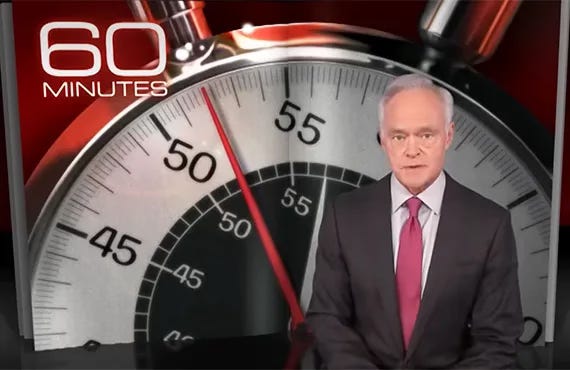
This story is far from over. There is a long way to go before that 60 Minutes stopwatch starts ticking.
Scott Pelley’s Statement (June 2. 2026)
There has never been anything in America like 60 Minutes.
The Sunday tradition is the most successful program of any kind in history. For more than a decade, its innovative growth on every major online platform has extended its reach to countless millions around the world. This spring, at the end of our 58th season, 60 Minutes grew rapidly with an unheard-of 9% jump in viewers on CBS.
“60” has been the number-one program in America for decades because our beloved audience finds integrity, quality, and humanity in our stories. When stewardship of the program passed to my colleagues and me, our responsibility was to expand energetically into a new age of media technology while preserving the values our audience expects. Now, the new owner of our network is casting this legend aside, apparently to curry a moment of favor with the Trump administration.
The waste is heartbreaking.
Last month, 60 Minutes lost its DNA when our entire senior leadership and two of our best on-air correspondents were cruelly fired without cause. Good people were silenced because they stood up for our audience. They stood for fairness against the forces of political bias; they stood for professionalism against chaos.
For my part, new management has instructed me to inject falsehoods and bias into a politically sensitive story. I’ve been told to include assertions that are unverified. To date, in every case, I have managed to ignore these instructions or refuse them. Recently, politicians have been invited to choose correspondents for interviews on the broadcast. Giving politicians control over 60 Minutes interviews is not how this is done. Finally, incompetence and unprofessionalism in the new management have wreaked havoc. In a case involving one of my stories, the entire program came within 19 minutes of not getting on the air at all.
At 60 Minutes, we have fought harder than anyone knows to save the program that became an American icon. We owed that to our millions of viewers. I am deeply moved by the thousands of wishes we have received to “keep up the good fight.” Most of the men and women of CBS News are still in that fight. But now the collapse of values at the top has become untenable. The leadership of 60 Minutes is no longer recognizable. The principles I hold dear are gone, and so I must leave as well.
I depart after 37 years at CBS with one emotion — a heart brimming with gratitude for the men and women of CBS News who encouraged and enriched my work, very often at the risk of their own lives. I pray for a day when those people and their ideals are honored again — a day when sanity, competence, and courage return.
- Scott Pelley
Thank you, Elliot, for this edition of TtF. I'll keep it short, rather than ranting about CBS, Weiss, Ellison, et al. After CBS capitulated to Trump and cancelled Colbert, so many of us committed to leaving CBS and Paramount+. For those who were on the fence about that, or weren't ready to make that commitment, I'm betting that Weiss' ruination of 60 Minutes, including hiring Bilton, will be the death knell of the network. Pelley's statement in the meeting with Bilton is exactly what was needed to highlight the rot at the helm. Thank you for including his full statement. It's a model of integrity in journalism that - I hope - will be taught in J Schools starting now and for decades to come.
These people need to join forces and create their own INDEPENDENT NETWORK... follow Meidas, Legal AF, Aaron Parnas, BTC....
We need to regain our VOICE!